Barred surfperch
Amphistichus argenteus
The fish most people actually catch from a California beach. What to put on the end of your line, how to read the trough they sit in, and why light gear beats heavy gear for them.
By Augustus Muse · Published September 23, 2026
The complete setup
| Part | What to use | Where |
|---|---|---|
| Rod | 9 to 10 ft, two piece, medium | Daiwa FT Surf Spinning Rod — 9', 2-Piece Medium |
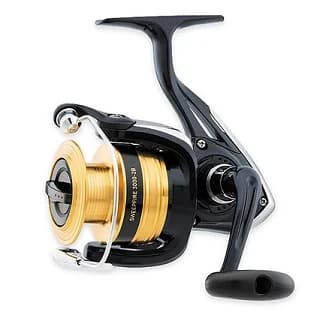
| Reel | 3000 size spinning | Daiwa Sweepfire 3000 Spinning Reel |
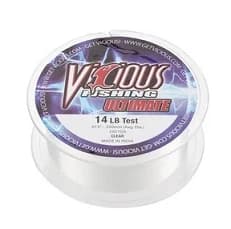
| Line | 25 lb mono, or 15 lb braid | Vicious Ultimate Monofilament — 25 lb, Clear, 330 yd |
| Leader | 12 lb fluorocarbon, 18 in to 3 ft | P-Line Floroclear Fluorocarbon-Coated Line — 12 lb, 330 yd |
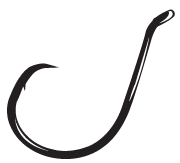
| Hook | Size 1/0 octopus circle | Gamakatsu Octopus Circle Hook — 1/0, Black Nickel, 6-Pack |
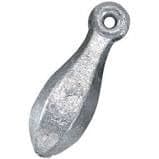
| Weight | 3 oz bank, on a sinker slide | MO's Bank Sinkers — 3 oz, 26-Pack |
| Bait | Sand crabs, dug on the beach | Free from the wash in front of you. Nobody sells these and nobody should. |
| Rod holder | A sand spike, so you can rig the second rod | Eagle Claw Sand Spike Rod Holder |
If you walk onto a sand beach anywhere on the California coast with a rod, the fish you're most likely to catch is a barred surfperch. They're there year round, they feed within a cast of dry sand, and they don't require a dawn start or a secret spot.
They're also the best fish to learn on. Everything that works for perch teaches you something that transfers to bigger fish later: reading a trough, timing a tide, keeping a bait moving in moving water.
Where are barred surfperch on a beach?
Closer than you think. The mistake almost everyone makes is casting as far as they can, which puts the bait past the fish and into empty water.
Perch sit in the trough, which is the deeper channel of water that runs parallel to the beach between the dry sand and the first sandbar. At low tide you can see it: a darker band of water where the waves aren't breaking, with white water on either side of it. That band is where you're fishing.
On many beaches the trough is inside thirty yards. Some days it's inside ten. A long cast is a wasted cast if it clears the trough entirely.
What's the best rig for surfperch?
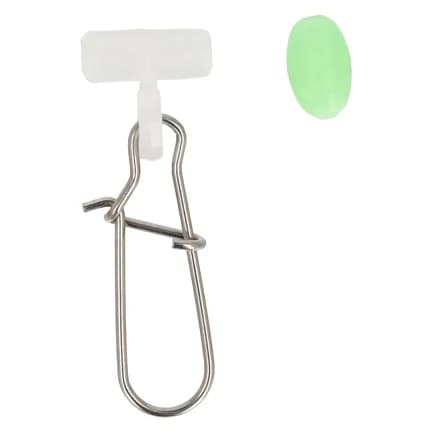
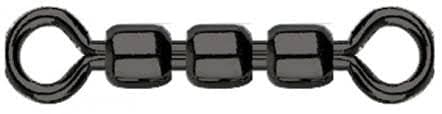
A Carolina rig, which most surf anglers call a fish-finder rig. Slide a sinker slide onto your main line, thread on a bead, tie on a swivel, then add a leader of eighteen inches to three feet and a hook.
The point of the slide is that the line runs free through it. A perch picks up a bait, moves off with it, and feels almost nothing because it isn't dragging the sinker. With a fixed sinker they feel the weight and drop the bait, and you never know they were there.
Keep the sinker as light as the conditions allow. Three ounces holds in most calm surf. Go heavier only when the sweep is moving your rig down the beach faster than you can fish it.
What hook size for surfperch?
Smaller than you'd guess. A barred surfperch has a small mouth built for picking sand crabs out of the wash, and a big hook simply won't fit in it.
Size 4 through 1/0 covers almost all perch fishing. If you're getting rattles and taps that never turn into a hooked fish, your hook is too big before it's anything else.
What bait works best for barred surfperch?
Sand crabs, and it isn't close. Perch eat them almost exclusively through the warmer months, and you can dig them out of the wash on the same beach you're fishing, for free. Look for the little V-shaped ripples in the receding water and scoop the sand underneath.
If you can't find crabs, a strip of market shrimp or a small piece of bloodworm will get bites. Soft plastics work too, particularly a small paddle tail or grub worked slowly along the bottom of the trough.
We've a guide on catching and keeping sand crabs if you want the detail.
What rod and reel do I need?
Less than the tackle shop will sell you. Perch are a one to two pound fish, so the rod is about casting a three ounce sinker and handling surf, not about fighting power.
A nine or ten foot two piece rod and a 3000 size spinning reel covers it comfortably. Fifteen to twenty pound braid or twenty five pound mono, and a fluorocarbon leader if the water's clear.
Being straight with you: every spinning reel our suppliers carry tops out at size 3000, and they're all rated by their manufacturers for freshwater. They work fine in surf if you rinse them properly after every trip. If you want a sealed saltwater reel in a 4000 or 5000, you'll need to buy that elsewhere, and we'd rather say so than pretend.

When is the best tide for surfperch?
Moving water, more than any particular height. A tide that's actively pushing or pulling stirs sand crabs out of the sand and puts them in the wash, which is when perch feed.
The two hours either side of low tide are popular because that's when the trough is easiest to see and easiest to reach. A pushing tide over a shallow beach also works well because it opens up water that was dry an hour before.
Slack water, at the top or bottom of the tide, is usually the slowest hour of the day.
Common questions
- Do I need a fishing license for surfperch?
- From a beach, yes, in California. From a public pier, no. Rules vary by state and change, so check your own state's wildlife agency before you go rather than trusting a tackle shop's website.
- Can you eat barred surfperch?
- Yes, they're good eating, and they're commonly kept. Size and bag limits apply and vary by state and sometimes by county, so look up the current limits where you fish.
- Why am I getting bites but not hooking anything?
- Almost always a hook that's too big. Drop to a size 4 or 1 and the same bites start converting. After that, check that you're letting a circle hook load rather than striking at it.