Circle Hook vs J Hook: Which Should You Use?
The two hook shapes do different jobs and you fight them differently. When a circle is the right call, when a J still wins, and why striking a circle hook pulls it straight out.
By Augustus Muse · Published October 10, 2026
This is the question that trips up more new surf anglers than any other, because the two hooks look similar in a packet and behave nothing alike once a fish picks up the bait.
The short version: circle hooks for bait you leave sitting, J hooks for anything you're actively working. The longer version is worth two minutes.
What's the actual difference?
A J hook is the shape you drew as a kid: a straight shank, a bend, a point aimed roughly back up the shank. It hooks a fish because you drive it in.
A circle hook curls the point inward, nearly perpendicular to the shank. It can't be driven in by a strike, because the point isn't facing the direction you're pulling. Instead, as the fish turns away with the bait, the hook slides to the corner of the jaw and the inward point catches there.
That's why the retrieve is different, and why most people get it wrong the first time.
How do you set a circle hook?
You don't. Let the rod load, then start winding steadily until it comes tight.
Striking a circle hook pulls it straight out of the fish's mouth before the geometry has a chance to work. If you're getting takes on circles and not connecting, this is almost always why, and it's a habit that takes a few trips to unlearn.
Which hook for which situation?
| Situation | Hook | Why |
|---|---|---|
| Bait in a sand spike, rod unattended | Circle | Hooks itself when the fish turns. A J hook on an unattended rod usually means a gut-hooked fish or no fish. |
| Bait fished in hand, striking yourself | Either | A J gives a faster, more certain hookset if you're paying attention. |
| Anything you intend to release | Circle | Jaw-corner hookups are far cleaner to unhook and the fish swims off in better shape. |
| Soft plastics on a jig head | J | The hook is moulded in and you're working the lure, so you set it. |
| Live bait you want swimming naturally | Circle | Lighter wire through the nose, nothing for the bait to fight against. |
| Sabiki or bait rig | Neither, they come rigged | Tiny dressed hooks sized for bait, not a choice you make. |
What size circle hook do I need?
Match the bait, not the fish. A hook has to sit inside the bait without crowding it, and a bait that can't move naturally doesn't get eaten.
For surfperch and corbina on sand crabs, size 4 to 1/0 is the range, and smaller is usually the fix when you're getting rattles that never connect. For bigger baits on the bottom, 5/0 through 8/0. Striped bass on a chunk of bunker is 6/0 to 8/0 territory.
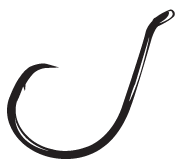
Terminal Tackle
Gamakatsu Octopus Circle Hook — 1/0, Black Nickel, 6-Pack
- Size
- 1/0
- Quantity
- 6
Rides along in a bigger order
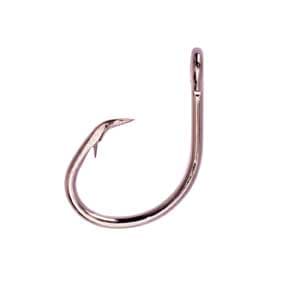
Terminal Tackle
Eagle Claw Lazer Sharp Circle Hook — 6/0, Black Nickel, 5-Pack
- Size
- 6/0
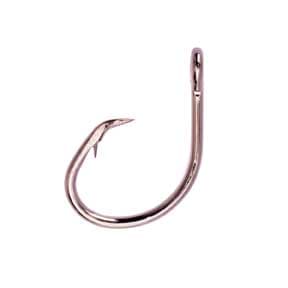
Terminal Tackle
Eagle Claw Lazer Sharp Circle Hook — 7/0, Black Nickel, 5-Pack
- Size
- 7/0
Is one more legal than the other?
In some places and for some species, circle hooks are required rather than recommended, particularly for billfish and in parts of the striped bass fishery. Rules vary by state and change, so check your own state's wildlife agency rather than a tackle shop page.
Common questions
- Do circle hooks work on soft plastics?
- Badly. A circle needs to slide to the jaw corner, and a plastic moulded onto the shank blocks that. Use a J-shaped worm or swimbait hook for plastics.
- Why did my circle hook gut-hook a fish?
- Almost always because the hook was buried too deep in the bait, or you waited too long before winding. A circle only works if it can slide, and a hook point packed inside a bait can't.
- Are offset circle hooks still circle hooks?
- Functionally they sit between the two. The offset makes them hook more aggressively, which also means they gut-hook more often. Where circle hooks are legally required it is usually non-offset ones that qualify.